
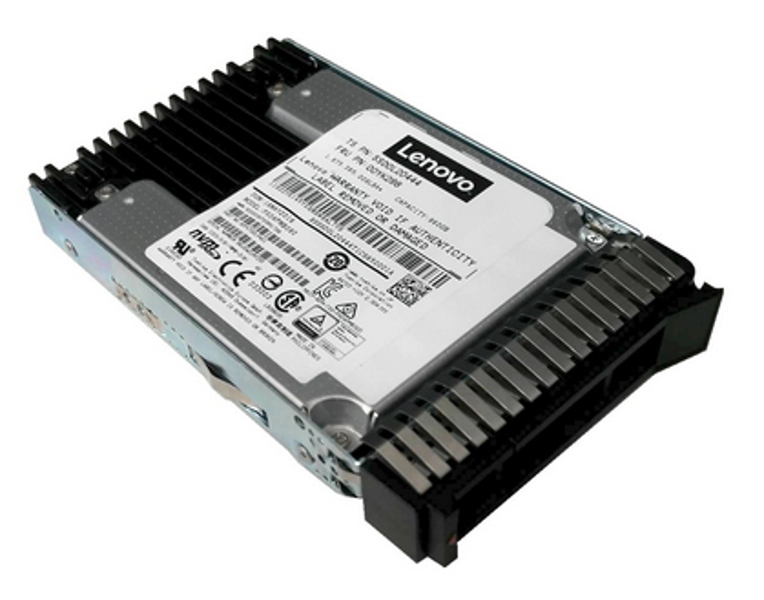
Lenovo PX04PMB - 800 GB - 2.5"
ThinkSystem U.2 PX04PMB - 800 GB - Performance NVMe - PCIe 3.0 x4 - Hot Swap - SSD
Brand: Lenovo
SKU: 7XB7A05923
£0.00
Price excl. VAT
£0.00
Price incl. VAT
Out of stock

Do you have any question about this product? Click here to contact our pre-sales consultant and make the right purchase.

Buy with confidence: honest stock, fair trade terms
Better prices with correct stock availability, and secure payments with full transparency.
- Aggregated live stock: availability shown is the combined aggregated stock of our warehouses and partner distributors, updated in real time. If it says available, it is available.
- No charge until confirmed: your payment is only reserved at checkout and is charged once your item is secured.
- 24-hour free cancellation: changed your mind? Cancel within 24 hours and the reserved payment is released in full.
- Stock sold out? Full refund: if an item becomes unavailable after you order, we cancel and release or refund 100% of your payment.
- From Our Warehouse to Your Door. every order is checked, packed at our warehouses and dispatched with DHL Express, UPS or FedEx as DDP – No customs or duties to pay. No hidden charges
- Fair cancellation and return terms: for late cancellations or returns of expensive, special-order items without a fault, a fee of up to 5-10% may apply, covering only actual shipping and handling costs to sustain our business. Faulty items and RMA cases are never charged. No late-payment fees, no interest ever. Full terms
 NOTE: The information below is provided for your convenience only; the accuracy of the specifications cannot be guaranteed. However, if necessary, please check with us before purchasing. Data provided by 1 World Sync.
General
SSD capacity
800 GB
SSD form factor
2.5"
Component for
Server/workstation
Lenovo PX04PMB. SSD capacity: 800 GB, SSD form factor: 2.5", Component for: Server/workstation
| Estimate Gross Weight | 0.5 |
|---|
https://lenovopress.com/lp0694-px04pmb-nvme-performance-pcie-ssd
Non-Volatile Memory Express (NVMe) is new PCIe 3.0 high performance SSD technology that provides high I/O throughput and low latency. NVMe interfaces remove SAS/SATA bottlenecks and unleash all of the capabilities of contemporary NAND flash memory. Each NVMe PCI SSD has direct PCIe 3.0 x4 connection, which provides at least 2x more bandwidth and 2x less latency than SATA/SAS-based SSD solutions. NVMe drives are also optimized for heavy multi-threaded workloads by using internal parallelism and many other improvements, such as enlarged I/O queues.
The Lenovo PX04PMB NVMe Performance PCIe SSD have the following features:
2.5-inch drive bay (U.2) form factor
Based on the Toshiba PX04P drives, PX04PMBxxx
19nm MLC NAND (128 Gb/die)
10 drive-write-per-day (DWPD) SSD for write-intensive workloads
Direct PCIe 3.0 x4 connection for each NVMe drive, resulting in up to 4 GBps overall throughput.
Full Power-Loss-Protection and End-to-End Data Protection
Low power consumption (maximum 18.5 W)
Enterprise Mainstream SSDs and Enterprise Performance SSDs have similar read and write IOPS performance, but the key difference between them is their endurance (or lifetime) (that is, how long they can perform write operations because SSDs have a finite number of program/erase (P/E) cycles). Enterprise Performance SSDs have higher endurance compared to Enterprise Mainstream SSDs. SSD write endurance is typically measured by the number of program/erase (P/E) cycles that the drive incurs over its lifetime, listed as the total bytes of written data (TBW) in the device specification.
The TBW value assigned to a solid-state device is the total bytes of written data (based on the number of P/E cycles) that a drive can be guaranteed to complete (% of remaining P/E cycles = % of remaining TBW). Reaching this limit does not cause the drive to immediately fail. It simply denotes the maximum number of writes that can be guaranteed. A solid-state device will not fail upon reaching the specified TBW. At some point based on manufacturing variance margin, after surpassing the TBW value, the drive will reach the end-of-life point, at which the drive will go into a read-only mode.
Even though Enterprise Performance SSDs have high endurance, careful planning must still be done to ensure that the total amount of data expected to be written to the drive over its life will not exceed the stated total bytes written (TBW) property of the drive.
For example, the 1.6TB drive has an endurance of 29,200 TB of total bytes written (TBW). This means that for full operation over five years, write workload must be limited to no more than 16TB GB of writes per day, which is equivalent to 10.0 full drive writes per day (DWPD). For the device to last three years, the drive write workload must be limited to no more than 26,667 GB of writes per day, which is equivalent to 16.7 full drive writes per day.
0.0
0 review(s)
In the building · Real shipments · Real operations
Goods in. Goods out. Real Tech, Moving Daily.
A snapshot of the technology we receive, handle, pack and dispatch. These images are captured on site or at customer locations — not from a stock library.